The week you stop carrying it in your head
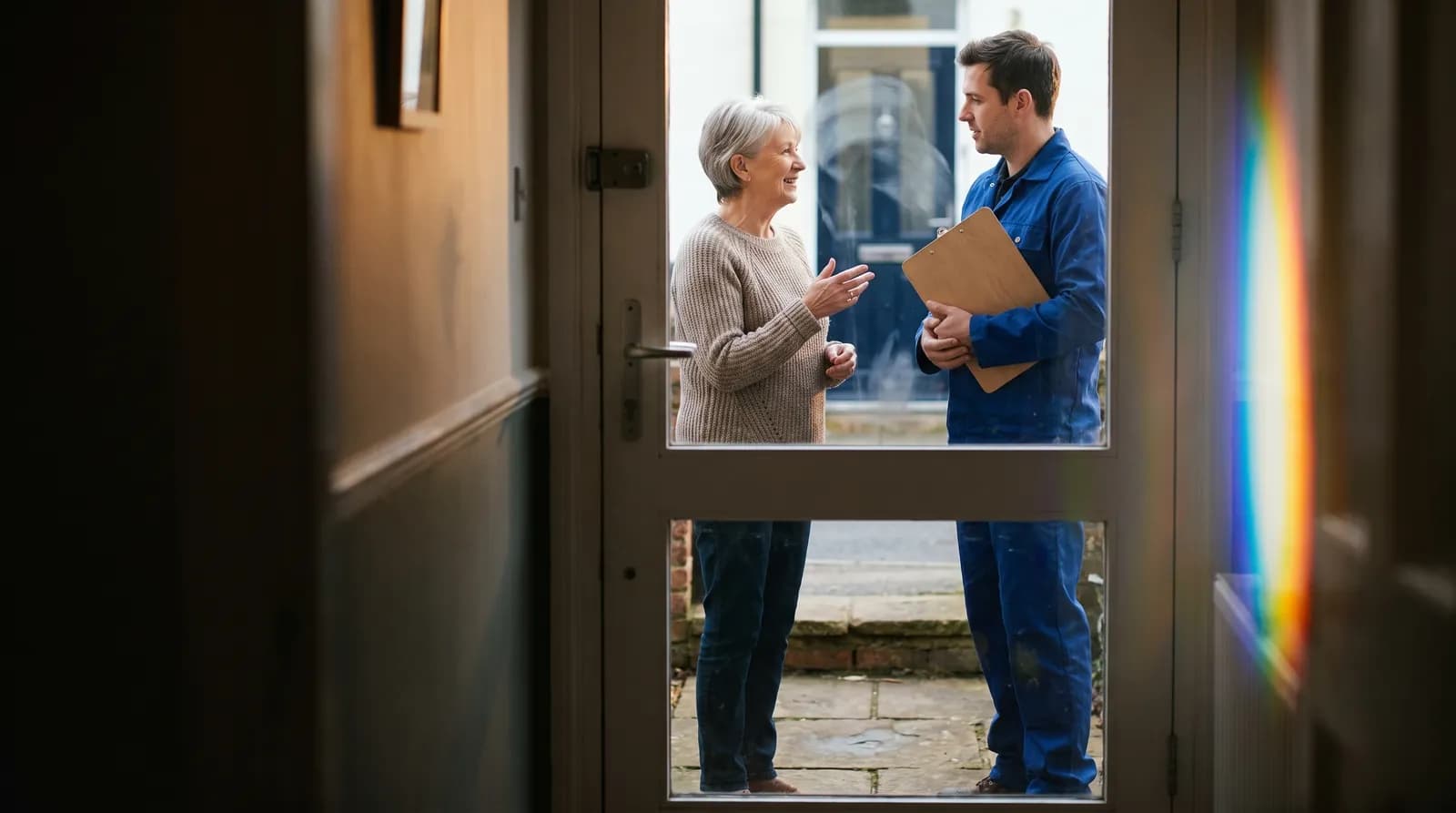
Right now you are holding the name of the part the plumber said he would order, the fact that the school trip money is due before half term, a reference number an adviser read out while you were walking back to the car, and something your sister said about your dad's appointment that you meant to write down and did not.
None of it is hard. All of it is load. The work of running a household is not the doing, which mostly takes minutes at a time. It is the holding, which runs all day and never finishes.
Why the list in your head costs so much
A thing you have written down is a thing you can put down. A thing you are only remembering has to be rehearsed, so you run the list at traffic lights, in the shower, and at four in the morning. The rehearsal happens while you are doing something else, which is why the attention it takes comes out of the evening with the people you live with.
The second cost is accuracy, and it is the one that actually bites. Almost every item on that list arrived by voice: someone standing in your kitchen, someone on a phone line, someone at a counter with the next person waiting behind you. Speech is where domestic admin happens and it is the only format nobody keeps. So the figure loses its last two digits, the caveat that came with the quote quietly drops away, and the date drifts by a day in your memory and by nothing at all in reality.
That is a fixable problem, because the missing piece is always the conversation itself. Record it and you keep the words, plus a summary cut to the length of whatever actually happened and the agreement lifted clear of it. That is what Meeting Notes makes of any recording, a kitchen-table ten minutes with a man holding a wrench included.
The conversations nobody writes down
It is worth seeing how much of a domestic year is conducted out loud and kept nowhere. These are the ones that come back later wanting to be remembered exactly.
- A tradesperson explaining what they will do, what it costs, and the one thing that would change the price.
- A call with a bank, an insurer or a utility, where the whole value is a reference number and the name of who you spoke to.
- Ten minutes with a teacher, a vet or a garage, delivered quickly because somebody is waiting behind you.
- A conversation with a sibling about a parent, which is half an arrangement and half something harder.
- A verbal quote given in a hallway, which you will be comparing against two others in a fortnight.
They share a shape. You are not at a desk, you are usually holding something, and the other person is talking at the speed of somebody who says this fifteen times a week. Writing it down while it happens is not really available, and pretending otherwise is why it ends up in your head.
Catching it while it is happening
None of this works if starting a recording means hunting for an app while a man in your kitchen is already talking about the valve. Hover puts a record button within one tap of whatever you are looking at, which is what turns this from an intention into a habit. Away from a screen entirely there is the Ona RecordPen, a Bluetooth pen you put on the table.
Five minutes, spread across a week
- Start it before the conversation doesThe useful part of a visit is the first ninety seconds, when somebody says what they have found and what they intend to do about it. If you wait until it sounds important you have already missed it.
- Say why, in one sentence"Can I record this? I will get the numbers wrong otherwise." The reason in it is plainly yours, and it costs nothing to offer. If the answer is anything other than yes, put your phone away and write it down the old way.
- Name it while you still know what it wasTen seconds, before you put the phone down: "Plumber, boiler valve" or "Car insurance renewal call". A week of recordings called Tuesday afternoon is a week you will not go back into.
- Read the summary the same dayTwo minutes, standing up. You are checking that the number, the date and the caveat survived, because those are the three things you were carrying and they are the three you can now stop carrying.
- Move the dates out and leave the restAnything with a time on it goes in the calendar, where it has always belonged. Everything else — the reasons, the caveats, the name of the part — stays in the transcript, and that is the half you were never going to write down anyway.
It helps to be specific about what actually degrades, because each item on your list is losing something slightly different.
| What you are trying to hold | What it turns into by Thursday | What the transcript still has |
|---|---|---|
| The quote for the work | A round number and a sense that it seemed fair | The figure, what it covered, and the thing that would change it |
| The reference number | Six digits, four of which you are confident about | The number as it was read out, and the name of who read it |
| What the garage said | Something about a bearing and a figure over four hundred | The two jobs, which one is urgent, and what happens if you wait |
| The date you agreed | A day either side of the truth | The date, and whether it was a promise or a hope |
| What your sister said about your dad | The arrangement, without the part that mattered | Both halves, in the words they were actually said in |
Asking instead of remembering
Once a few weeks of this exist, the habit changes. Ask Ona reaches back through the transcripts themselves and shows its working, so whichever conversation an answer is resting on is one tap away and you can go and read the sentence yourself.
The questions are small and constant, and they are exactly the ones you currently answer by standing still in a hallway trying to remember. What did the letting agent say about the deposit. How much was the second quote and what did it leave out. When did the garage last say the belt was done. Which of the two dates did we actually agree to.
The change is smaller than it sounds and it is the entire point of the exercise. You stop being the storage. The list in your head shortens to the things you have actually decided to do, which is a list that ends, and the rest of it is somewhere you can ask.
I used to run a permanent inventory of half-remembered numbers. Now the quote, the reference and the date are in a recording I made at the door, and the only thing I carry is what I have decided to do about them.
Rhea M., Operations Lead, wholesale distributor
When the load is shared, badly
In most households this work is not split evenly, and the reason is rarely unwillingness. It is that the person who had the conversation is the only person who has it, so everything has to route through them, and asking for help means first performing a full retelling at the end of a long day.
A recorded conversation gives you something better to hand over than a retelling. You read the summary, pull out the three lines that matter, and send those. The other person gets the quote as it was given rather than your compression of it, and the handover takes a minute instead of an argument about what the man actually said.
The same is true in the other direction, for the things you are the one being told. A conversation you were not in, summarised by the person who was, is the most common way a household ends up with two slightly different versions of a plan. There is more of this — the parts of a week that are not a work week — on Ona for personal life and productivity.
The part of the load it does not take
It does not do any of it. A recording of a conversation with a garage is not a booked appointment, and a summary containing a date is not a reminder. The calendar still holds the dates, the phone call still has to be made by you, and the part of this that feels like work will feel exactly the same afterwards.
It also ages faster than you expect. Domestic arrangements are renegotiated by text message, and a text message is not a conversation. The plumber says Tuesday in your kitchen and moves it to Thursday by message on Monday night, and the transcript is still confidently saying Tuesday. A record is accurate about the moment it was made and nothing after it, and household facts have a shorter half-life than almost anything else you could record.
Then there is the obvious one, which is worth saying flatly. Your home is not a workplace and the people in it never agreed to anything. Do not become the person who records their family. Record the tradesperson, the call with the insurer, the ten minutes with the teacher — conversations that are transactions, with someone doing a job — and leave the rest of your life alone. A house where somebody might be recording is a worse house to live in, and no amount of admin saved is worth that.
There is one more thing to settle before any of this becomes routine. A recorded telephone call and a recorded conversation at your own kitchen table are not governed the same way; the answer moves depending on where you live and occasionally on who you have dialled; and a company announcing that it records for its own purposes has told you precisely nothing about yours. That is a question for somebody local and qualified, and it is not one this page can settle on your behalf.
Living with it at home
It is much less than it sounds. Most weeks contain two or three conversations where somebody tells you something you will have to act on, and those are the only ones worth catching.
The test is simple: is there a number, a date or a condition in this that I will need to be right about? If not, let it go unrecorded.
Those are already written down, and Ona does not hold them. Nothing here is trying to be the place all of your admin lives.
This is only for the part of running a household that has always existed as speech and then stopped existing at all.
Then it is strange, and that is a reasonable thing for them to feel. The answer is not to persuade them; it is to keep it narrow.
Use it for calls with companies and for conversations where a figure is going to matter later, and keep it out of the kitchen. Nobody has to agree with a household policy that does not touch them.
Put one thing down this week
Record the next conversation that arrives with a number in it — a quote, a booking, a call with an insurer — and stop rehearsing it on the way home.