From lecture to revision notes
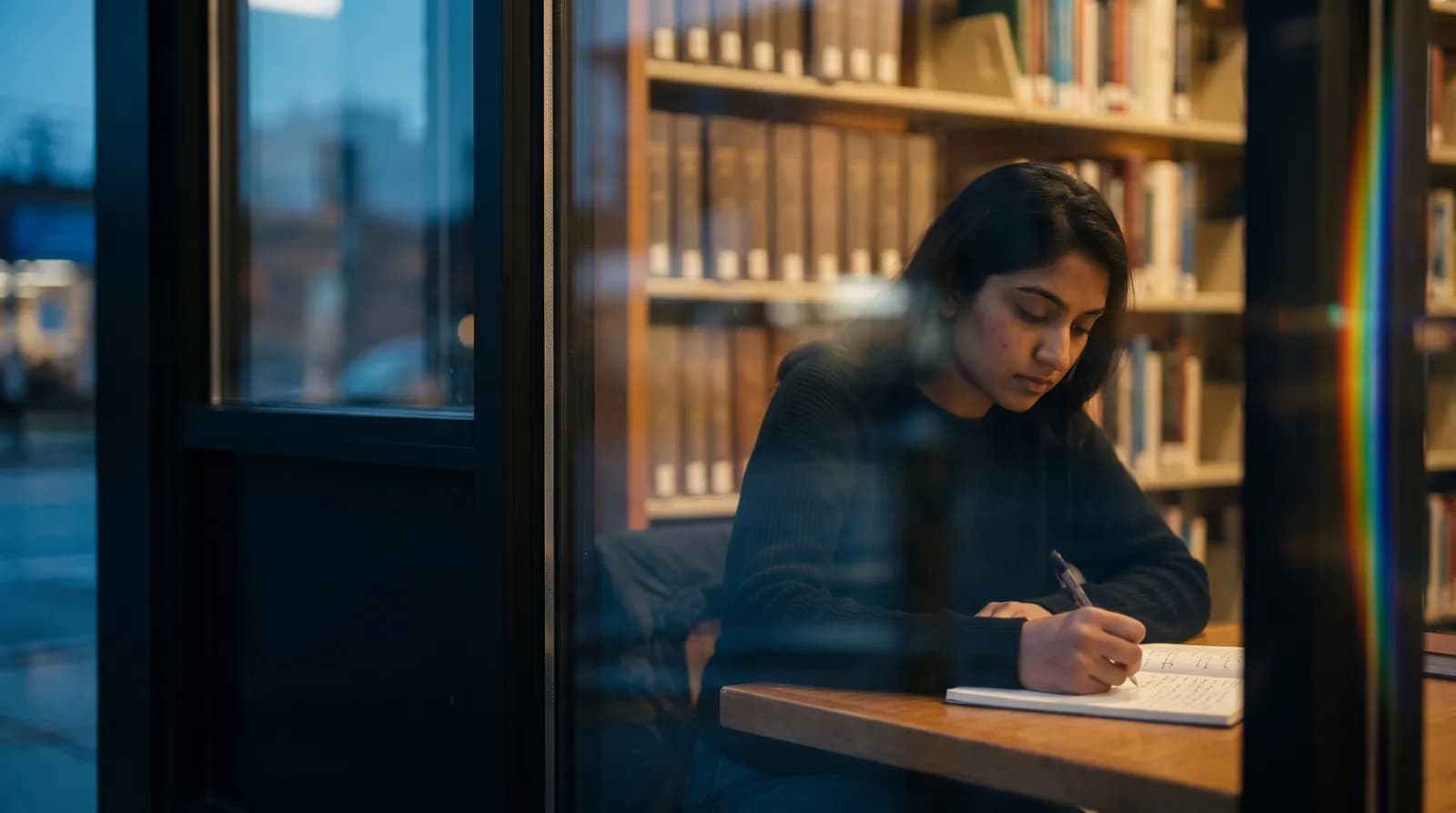
It is April. You have eleven lectures on one module, forty-eight hours, and a notebook whose middle third consists of the phrase "see slides". The hard part of revision is not that you have forgotten the material. It is that there is nothing to revise from.
This is a playbook for fixing that during term rather than in April, and for spending less time in the lecture writing, not more. It begins with a step you cannot skip.
The note-taking trap
Most students, faced with an hour of new material, try to write it all down. It is the obvious response and it is the worst available option, because it fails twice. You cannot follow an argument while transcribing it, so you understand less in the room. And what you end up with is a slower, less accurate copy of the slides, which the lecturer has already given you.
The alternative that actually works is to write much less and listen properly. The objection to it is obvious too: then you have nothing in April. Which is true, unless something else is keeping the record for you.
That is the whole trade this playbook makes. If the lecture is recorded, with permission, it becomes a transcript and a summary sized to the material, with the main points and any stated conclusions pulled out of it, which is what Meeting Notes produces from any recording. Your job in the room changes from stenography to understanding.
One warning before the routine, because it is the way this most often goes wrong. A transcript you never read is worse than bad notes, not better, because it feels like having the material. A folder of eleven unread lectures in April is eleven hours you do not have. Everything below is about the twenty minutes afterwards, which is the part that does the work.
The routine, one lecture at a time
Five steps. The first two happen in the lecture hall, the rest on the way home, and the three that happen afterwards cost about twenty minutes per lecture between them.
An hour in, twenty minutes out
- Get permission, then start the recordingFrom your phone, from the web, or with the Ona RecordPen, a Bluetooth pen you can set on the desk. Each one is started by you and shows that it is recording while it runs. Note that institutions generally treat a pen recorder exactly as they treat a phone, so it does not route around a policy that says no.
- Write five lines, not five pagesOnly two things are worth writing by hand: what you did not understand, and what the lecturer leaned on. "Slow down here", "this comes up in the exam", a diagram drawn twice. Those signals are invisible in a transcript and obvious in the room.
- Read the summary the same dayTen minutes, on the bus, while the hour is still attached to a memory of sitting through it. This is where you find out whether you followed it, and it is much cheaper to find that out in October than in April.
- Turn the summary into questionsNot paragraphs. Questions, with the answers written underneath in your own words. "Why does the second condition fail without the first?" beats any amount of highlighted prose, because in April you can cover the answer and find out whether you know it.
- Check the hard ones against the lectureFor the two or three you could not answer, go back to the ninety seconds where it was explained rather than the whole hour. That is the one use of the transcript that genuinely pays.
What the five lines should say
Step two is the one people get wrong, because five lines feels like too few and the instinct is to creep back up to two pages. It helps to know exactly what you are hunting for. Everything on this list is something a transcript cannot give you afterwards.
- The sentence you did not follow, copied as closely as you can manage, so you can find it again.
- Anything the lecturer repeated, slowed down for, or drew on the board twice.
- A term used as though you already knew it, which usually means you were supposed to.
- The question you would ask if the hall were empty.
- A reading mentioned in passing rather than one printed on a slide.
None of these are the content of the lecture. They are your relationship to it: where you fell off, where the emphasis was, what you would ask. That is exactly the material the summary cannot contain, and it is why five handwritten lines beat a full transcription you produced yourself.
Step five is worth a note. Ask Ona answers from the lectures you have recorded and names which lecture and which moment each part of the answer came from. Use it to find the ninety seconds, then read them. Reading a generated answer and believing you have understood it is the most efficient way to fail an exam that has ever been invented.
Four ways to spend the hour after a lecture
The reason the routine is built around questions rather than notes is that most revision techniques feel productive in proportion to how little they achieve.
| What you do | How it feels | What you have in April |
|---|---|---|
| Reread your notes | Productive and calm | Recognition, which is not the same thing as recall |
| Read the whole transcript back | Thorough | An hour gone and roughly the notes you started with |
| Read the summary, write five questions | Uncomfortable | Five questions you can either answer or cannot — which is the list you needed |
| Nothing | Entirely fine at the time | A transcript you are not going to open |
The third row is uncomfortable on purpose. Writing questions forces you to find the edges of what you understood, which is unpleasant in week three and extremely useful in week twenty-two. The other three rows are all versions of meeting the material again and mistaking familiarity for knowledge.
Across a term, not across an hour
The per-lecture routine is the small half. The part that changes how a module feels is being able to ask across all eleven at once: where a term was first defined, which lectures covered a topic, what the lecturer said about it in week two that contradicts week nine. Modules are not built lecture by lecture, and revising them that way is why the shape never arrives until the night before.
A Routine can do the collecting for you: one short brief per module at the end of each week, listing what was covered and what is still unanswered in your own questions. Reading six of those in an hour is a better use of a revision day than reading any single lecture twice.
There is a useful asymmetry here worth knowing about. Your question bank is yours: you wrote it, and swapping it with three coursemates before an exam is one of the most efficient hours of a degree, because everybody's list of unanswered questions is different. The lecture is not yours in the same way, and passing on a recording or transcript of it is the thing institutions are most likely to treat as a serious breach. Share the questions, keep the lecture to yourself.
The same habit works for the parts of a degree that are not lectures at all. Supervision meetings, lab briefings and project check-ins are where most of the specific instructions live, and they are almost never written down by anybody. The Ona for knowledge work and education page covers what that looks like across a term.
I stopped trying to type everything in lectures. Now I write down the parts I did not follow, read the summary on the bus, and turn it into questions. Revision is answering those questions instead of meeting the material for a second time.
Amara O., second-year student, large public university
What it will not learn for you
It will not do the understanding. Any question you can answer straight off a summary is a question you already knew; the ones you cannot are the actual work, and the work is entirely yours. A tool that makes the easy questions faster and leaves the hard ones untouched is only useful if you go and do the hard ones.
A lecture is also not the reading. Most courses use the hour to map a reading list, and a summary of the map is not the territory. If a lecturer spends four minutes on a paper, the four minutes are a pointer, and the paper is still the thing you have to read.
Transcription struggles with exactly the vocabulary a degree is made of: technical terms, surnames, anything with notation in it, and anything spoken quickly at the end of an hour. Equations and diagrams do not survive audio at all. Check anything precise against the slides, and treat the transcript as a way back into the lecture rather than a source you would quote.
And the permission question is not answered once. It applies again to every module, to any guest lecturer, and to recordings someone else made and offered to share, which frequently breach the rules even when your own recording would not. Sharing a lecture recording is the line most institutions are strictest about, and it is not yours to cross on someone else's behalf.
Around the lecture
Then you do not record that lecture, and there is no version of this where you do it anyway. Ask whether a recording is already provided — many institutions capture lectures centrally and release them, which is permission-free by definition.
If there is nothing, the five-lines habit still works on its own. Write what you did not follow, and take those questions to a seminar or an office hour.
The rules are stricter there and for good reason, because the other people in the room are students rather than staff, and what they say is not part of anyone's job.
Ask the room and not just the tutor, and accept a single no from anyone as a no for everybody. A seminar where one person is guarded because they are being recorded is a worse seminar for all of you.
Recording a lecture you are permitted to record, and writing your own questions from it, is studying. Nothing in this playbook produces text to submit, and you should not use it that way.
Your institution's rules on AI use are a separate set of rules from its rules on recording, and both apply to you. Read them rather than assuming either one covers the other.
Turn one lecture into questions
Check your department's policy first. Then record a single lecture, read the summary the same day, and write down the five questions you cannot yet answer.